A single satellite image can show where the crop is weak today. A useful management zone should tell you something more durable: where the field tends to behave differently across years.
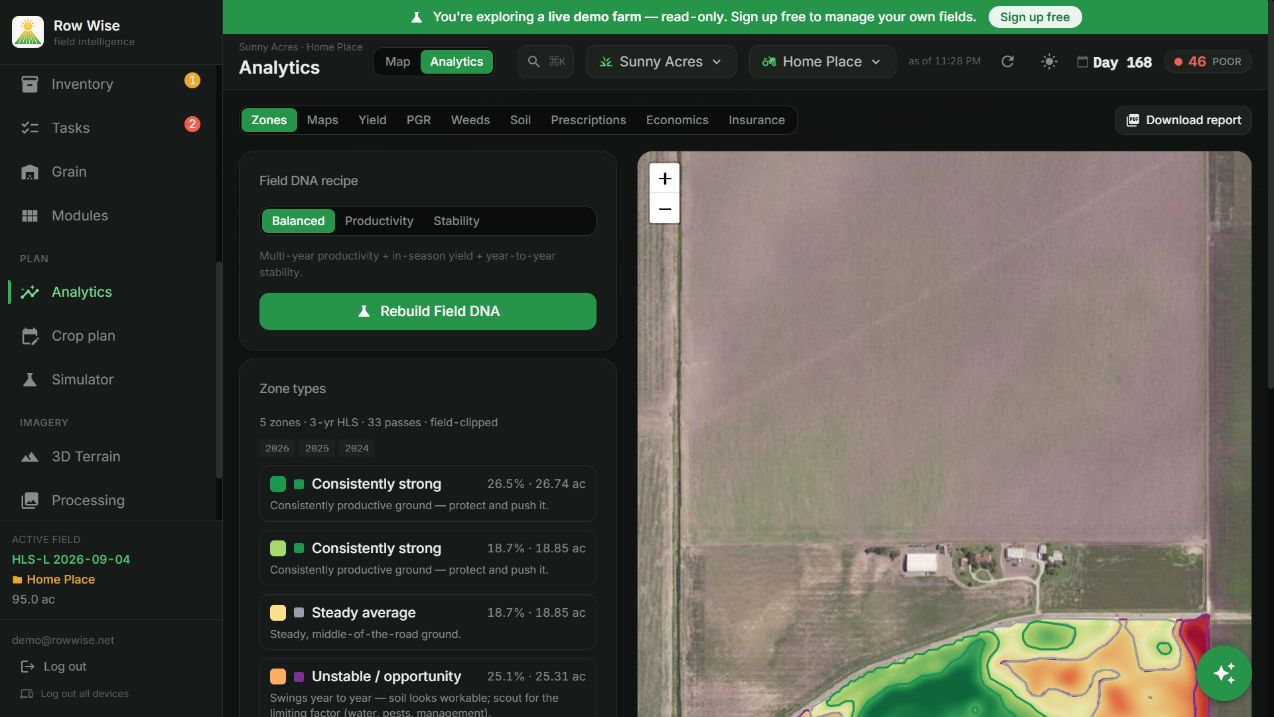
Stable and unstable ground are different problems
Consistently strong ground is usually the easiest zone to understand. It performs well repeatedly, so the job is to protect what is working. Consistently weak ground needs a harder question: is the limitation fixable, or would more seed and fertilizer only raise cost?
The interesting zones are often the unstable ones. A patch that swings from strong to weak may be sensitive to rainfall, drainage, irrigation timing, compaction or another seasonal factor. That area can have more upside than ground that is predictably poor, but it also needs more investigation before you change a rate.
Three checks before you write a prescription
- Check the years. Make sure one unusual season is not doing all the work. Drought, flooding, hail or a changed crop can distort the pattern.
- Check the ground. Compare zones with soil maps, elevation, drainage and your own memory of the field. The map should make physical sense.
- Check harvest. Import a combine yield map when you have one, or at least record the whole-field yield. Satellite vigor is a proxy until it is tied back to harvested production.
Keep the first prescription conservative
The first variable-rate pass is an experiment. Avoid a huge spread between zones unless you already have strong local evidence. Use rates you can explain, preserve an untreated or standard-rate comparison where practical, and save the prescription so you can review it after harvest.
Exclusions matter as much as rates. Waterways, wet holes, headlands and non-crop areas should not receive an automatic rate just because they fall inside a boundary.
Close the loop after harvest
Once the crop is off, bring the yield map back into the same zones. Ask whether the high-rate areas paid, whether weak zones stayed weak, and whether an unstable zone became more consistent. One season will not settle every question, but it will make the next prescription less generic.
Management zones are useful when they preserve what you know about a field and make the next decision easier to test. They are not useful when they turn a colorful map into false precision.